
The twenty seventh UN Conference of the Parties (COP 27) was held in Sharm-el-Sheikh, Egypt, in November. ‘Parties’ refers to the countries that signed the United Nations Framework Convention on Climate Change (UNFCCC), a treaty that came into force in 1994. There are now 193. The Egyptians dubbed it “the conference of implementation”.
Just before the COP the United Nations Environment Programme (UNEP) issued a familiar report, the so-called “emissions GAP report”(1) pointing out that the current emissions programme would lead to an increase in global temperature of 2.8°C above pre-industrial levels and that a 30% reduction in emissions by 2030 is required to limit global warming to a 2°C rise. The possibility of achieving the famous 1.5°C temperature rise by 2100 (needing a 45% reduction in global emissions yet solemnly pledged at the Paris COP in 2015) is now effectively dead. Despite the fine promises made at the Glasgow COP, it was also reported that 2022 was all but certain to be the year with the highest emissions ever.(2)
The UN secretary general, Antonio Guterres, set the tone of the conference by announcing “humanity is heading for collective suicide.” This apocalyptic warning, plus the GAP report, were intended to galvanise the COP into decisive action.
Did it work?
Even asking this question verges on the ridiculous. All previous COPs have failed to deliver any reduction of emissions and this one, far from being “the conference of implementation”, followed the same well beaten path. It was probably worse than previous COPs. However, it is still worth a brief look at what happened, bearing in mind that the egregious failures of Glasgow were supposed to be rectified at this COP.
== Failure at Sharm-el-Sheikh
45,000 delegates attended, including 636 oil and gas company lobbyists who were sponsored delegates. (BP’s chief executive, Bernard Looney, plus four other BP executives, even attended as official UN delegates for the West African state of Mauritania!) Many of the participants arrived in private jets without even a gesture to reduce their own carbon emissions! The whole COP performance has been appropriately described as an expensive bloated “travelling circus.” It ended with no formal agreement to reduce fossil fuel use. Instead, the side meetings were used to sign deals for exploitation of timber and minerals(3) and, of course, for the oil and gas reps to meet with mainly African heads of state to lobby for new drilling concessions. This was justified, we were told, by the Ukraine war and the need to “dash for gas.” Thus, COP 27 is likely to lead to even more extraction of oil and gas and more carbon emissions. Precisely the opposite of what was intended.
A glance at the COP 26 pledges and the failures which were supposed to be rectified in Sharm-el-Sheikh shows no progress on all important issues.
The salient feature of COP 26 was its failure to eliminate burning of coal by 2040. The International Panel for Climate Change (IPCC) calculates this must be phased out in OECD countries by 2030 and globally by 2040. A host of countries rejected this in Glasgow. India, for example, still maintains it will only eliminate coal by 2070. There was no mention of this issue, confirming how empty the Glasgow pledge to “phase down” coal burning was.
The parties were supposed to present new emissions reduction plans. Only 24 of the 193 attendants submitted improved targets. Methane (CH4) reductions agreed at Glasgow have not been achieved. Instead, 2021 saw the highest ever methane emissions. Meanwhile, deforestation has continued with 7 million hectares of forest cut down since COP 26. Forests are now emitting more carbon than they are absorbing. Also the $100bn which was supposed to be provided annually from 2020 to developing countries has not been met. It appears most of what has been provided has taken the form of loans not grants.(4)
The one supposed triumph of this COP was an agreement to set up a “Loss and Damage” fund for countries suffering the effects of climate change. How it is to be funded and controlled is unclear. What is clear is that it is not an attempt to counter the causes of climate change but a sticking plaster attempt to mitigate its effects.
What are the effects of the climate change we have seen in the last year?
== State of the Planet
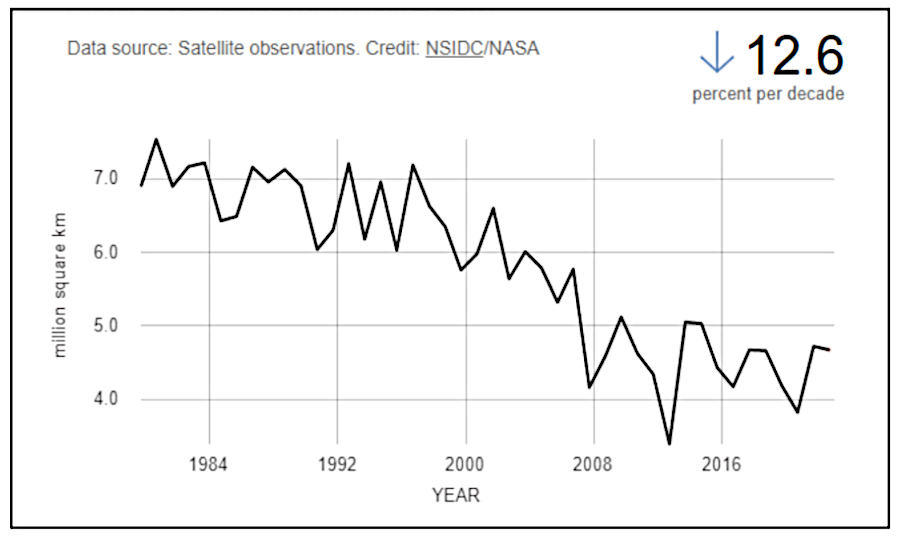
The Arctic is the bellwether for what is in store for the planet. It is warming 3 times faster than the rest of the planet and sea ice and snow cover are melting at unprecedented rates. Ice area measured in September had decreased from 7 million square kilometres in 1984 to 4.6 million in 2022. The US national space agency (NASA) calculates from satellite data that 12.6% of sea ice is being lost each decade.
http://www.leftcom.org/files/arctic-sea-ice.jpg
Snow covering in June was shown to have reduced by 6 million square kilometres between 1980 and 2012. Sea ice and snow reflect incoming solar radiation back into space via what is called the “albedo effect”. The snow on its own reflects 90% of the incoming radiation and ice on its own reflects between 50% and 90%. The sea water, because it is dark, only reflects 10%. Loss of sea ice from the 1970s to 2012 reduced the “albedo effect” and caused additional warming, equivalent to 25% of all the CO2 added in this period. Similarly the loss of snow covering on ice and arctic lands caused another additional warming, equivalent to 25% of all CO2 releases in this period. In other words, these two effects amount to a further 50% of additional warming to the whole earth or an additional 0.21Watts per m2 over the whole world.(5)
Arctic warming is affecting the jet stream and the ocean thermohaline circulation of sea currents and is starting to create dramatic changes in the current weather. The jet stream arises from temperature differences between the cold air of the Arctic and warmer air from lower latitudes and can create winds of up to 200 miles per hour at high altitude. As the temperature difference between these two lots of air decreases the jet stream starts to slow down and to meander. One side of the jet stream has very cold air and the other has hotter air. In 2021 we got an indication of the sort of effects we can expect from this process. The village of Lytton, north of Vancouver in Canada, got hit by the high temperature side of the jet stream in August 2021 and experienced a so-called heat dome suffering temperatures of 49°C, resulting in fires which burned down most of the village. On the other hand, Texas in February 2021 got hit by the other side of the jet stream and suffered a freeze of minus 19°C leaving 4.5 million homes without power. The jet stream, of course, also controls weather in Europe which has also seen heat waves and drought. But these changes are not just producing local effects, their impact is worldwide. The devastating floods in Pakistan last year are an example. They affected 33 million people, equivalent to half the UK population, and destroyed 900,000 homes as well as livestock and crops and infrastructure. 20 million people are now homeless and require food aid. In Africa the worst drought in 40 years has left 164 million people unable to grow crops and suffering extreme hunger. China has suffered the worst heat wave in its history; Australia the worst drought, and subsequently, catastrophic floods.
Melting of the ice on Greenland and Antarctica, which is causing the rise in sea level, is proceeding very much faster than the IPCC estimated. NASA satellite measurements in 2016 revealed that 300 cubic kilometres of water were being released into the sea by the Greenland ice melt annually and 84 cubic kilometres by the West Antarctic ice sheet melt. This melting process is not linear and will accelerate as it proceeds. Further, the West Antarctic ice sheet is becoming unstable. Its collapse into the ocean would raise sea level by several metres.(6) Low lying areas of the world are likely, sooner or later, to become uninhabitable.
In the northern hemisphere weakening of the Gulf Stream will upset the fairly regular climate sequence of ice ages and interglacials(7) which we have experienced throughout our evolution from the stage of _Homo erectus_ 1.8 million years ago to _Homo sapiens_ today.
Another very important consequence of Arctic warming is the release of methane from the permafrost and undersea deposits. During the last ice age methane combined with water to form methane hydrate and was frozen into the silt deposits of the continental shelf which was subsequently flooded about 15,000 years ago. It is only stable at low temperatures or high pressures. The temperatures in the shallow areas of the Arctic seas have been at zero degrees since the Ice Age. However, with the ice melt, much warmer water(8) is impinging on the frozen sediments and releasing the stored methane. In the longer term methane is about 25 times more powerful a greenhouse gas than CO2. It is estimated that the methane in the ocean deposits stored in the Arctic continental shelf contain approximately 13 times the amount of carbon at present in the atmosphere. There are between 800 and 1,400 Giga tonnes (Gt)(9) of methane waiting to be released. The release process has not been scientifically studied but it appears that between 4 and 8 Gt is being released annually. For comparison, annual release of CO2 is approximately 35 Gt. If these figures are correct the global heating effect of methane release is already significantly greater than the CO2 annual emissions. Stored methane is without doubt the equivalent of an unexploded climate bomb which the capitalist mode of production has brought to the point of detonating.
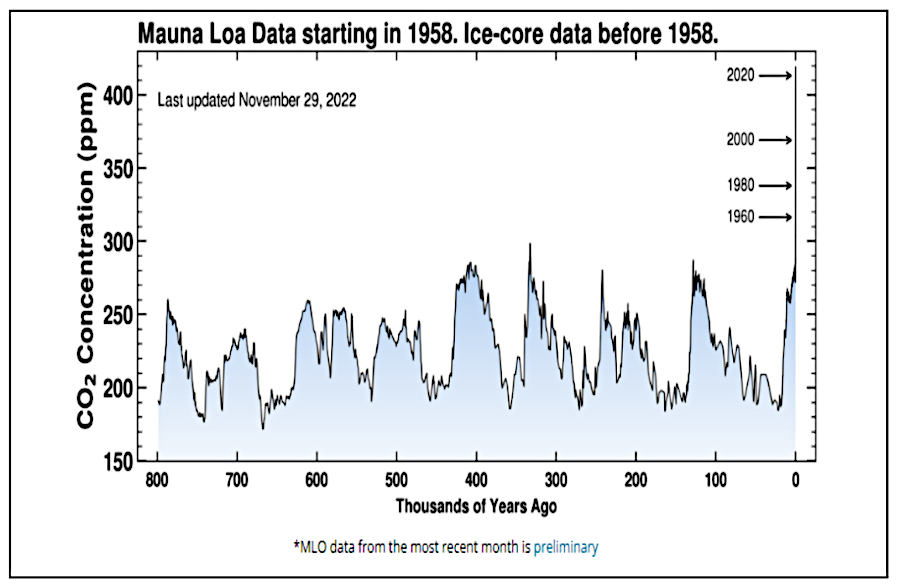
What has been studied in detail is the concentration of CO2 in the atmosphere in both the present era and, via analysis of ice cores, for the previous 800,000 years. These studies indicate that the concentration of CO2 in the air corresponds fairly closely to the temperature. During the ice age concentration of CO2 was on average about 180 parts per million (ppm) and during the interglacial period about 280 ppm. Now that concentration is 420 ppm — 140 ppm higher than the stable interglacial concentration within which our species survived for the entire Pleistocene geological period.(10) If we are to believe the GAP report, mentioned above, and the IPCC report AR6,(11) current CO2 concentrations are leading to a general rise in temperature of 2.5 to 2.8°C. This would be equivalent to conditions in the mid-Pliocene period(12) when there was no sea ice and sea levels were 25m above present. In this period our ancestors, probably _Australopithecus afarensis_, were a very few ape-like animals living in central Africa. Most, if not all, of the present human race would not survive such a change but it is a typical sleight of hand of spokesmen for the capitalist world order like UN Secretary General Guterres to talk of a collective suicide pact. A suicide pact implies that the people in it have made a mutual decision. But who amongst the world’s wage workers have had any significant influence over emissions policies? Moreover, what needs to be understood is that such a change is coming due to the CO2 that has _already_ been emitted, not future emissions. So long as the present mode of production continues future CO2 and methane emissions will only make a bad situation much worse. We have no carbon budget we can burn through, nor is a zero emissions policy going to save us, as the politicians pretend.
http://www.leftcom.org/files/CO2-concentration.jpg
== So What Can Be Done?
We must either reduce the amount of CO2 in the atmosphere to get back to stable interglacial levels(13) or reduce the solar radiation reaching the earth. Schemes for doing both of these have been proposed by scientists but generally entail further ruinous ecological effects or produce as much CO2 as they capture. All proposals have been subjected to the test of capitalist economics, in particular expenditure and profit. Needless to say, all have failed these tests. As long as capitalism is the system of production worldwide, all attempts to deal with the climate crisis will be made within the bounds of capitalist production and social relations. They will therefore be subject to the constraints of profit and loss and will fail.
Why Do the COPs Achieve Nothing?
Fossil fuel production is extremely profitable and thus a key sector of global capitalism. For this reason it is directly supported by the most powerful nation states. Over the last 50 years oil companies have, on average, made profits of $2.8 billion per day while receiving $64 billion per year in state grants.(14) Hence the reluctance to implement any serious measures to restrict the operation of oil and gas extractors. Further, the fact that capitalism is structured into competing nation states means that international agreements which would disadvantage a major state will not be agreed. After COP 27 the UK government, for example, issued over 100 new licences for oil and gas extraction in the North Sea and also approved construction of a new coal mine in Cumbria. This trashing of climate pledges was justified using the alibi that higher fuel prices caused by the Ukraine war meant the UK needed to look after itself: so, produce more fossil fuels not less as well as coal for export! The hypocrisy of governments is complemented by the furious rear-guard action of the oil companies themselves to discredit global climate science, including blatant efforts to vilify the top scientists involved. What Marx noted about bourgeois economics applies almost word for word in regard to oil companies’ attempts to undermine climate science.
"It is no longer a question of whether this theorem or that is true but, whether it is useful to capital … In place of disinterested inquirers there are hired prize fighters; in place of genuine scientific research, the bad conscience and evil intent of apologetic.(15)"
Even if the attempts to deny global heating have now largely collapsed under the weight of empirical evidence this does not alter the drive to continue “business as usual” and so the emission of greenhouse gases. The prize fighters’ denialism has morphed into nihilism with the idea, which can only be classed as nonsense, that the problem can be left to future generations to solve. Clearly, the short term interests of capitalist profits trump any long term interests of humanity.
However, it is not simply because the capitalist class are generally hypocrites and liars, which they clearly are, that they act in this way. Their actions are dictated by the needs of the capitalist system itself, specifically the need for profit and for continual accumulation of capital which is equivalent to continual growth. Global heating is thus a systemic problem of capitalism itself and it cannot be solved while capitalism remains the global system of production.
As we wrote in RP19:
"Since it is the system itself which is driving this process, we can see why attempts to reform it via Green New Deals or civil protests and disruption, as pursued by “Extinction Rebellion” or “just stop oil” in the UK, will also fail. As long as global capitalism rules the world, we will continue the headlong route to the inferno and mass extinction. To avert this, we need a change of historical proportions. The historical alternative is basically: either the breakdown of capitalist civilisation, through global warming or war, leading to massive destruction of human life … or, alternatively, the replacement of capitalist production by a higher form of production and a new form of social organisation.(16)"
How can the second alternative be achieved?
== Communism is All That Can Save Us
A new social system in which production is for human needs must be constructed. This implies a society of freely associated producers in which all the hallmarks of capitalism such as the necessity to work for a wage, commodity production, money, national states and their boundaries are abolished. Such a social system needs to be run democratically via a worldwide network of workers’ councils. This is what we mean by communism, though it clearly has no similarity with the system of state capitalism which existed in Russia up to 1991.
Capitalism is a class-divided society and the capitalist class who control this society need to be overthrown before a new society can be born. The global working class is the only class with the collective strength and the material interest in abolishing the existing order. At present, however, this class lacks consciousness, organisation and the political direction to accomplish this historic task. The construction of a political organisation to assist the world’s workers to regain revolutionary consciousness and political orientation is the vital task of the present epoch.
A communist society will be able to plan for the long term to restore its ecological balance with nature. Of course, we will have to face the massive problems left to us by capitalism. However, once freed from the constraints of profitability and continual accumulation, we will have a better chance of solving the impending climate catastrophe and this will be a prime task of the new society.
As for today’s eco-warriors, their attempts to make the ruling class see the error of their ways so as to reform the system are a complete waste of time and effort. The only political task worth engaging with is helping to construct an international political organisation of the working class to assist in the overthrow of capitalist society. This is the only realistic possibility of combatting the climate catastrophe.
-- CP _
Communist Workers’ Organisation
== Notes:
Image: https://commons.wikimedia.org/wiki/File:Dorian_2019-09-01_1601Z.png

(1) Emissions Gap Report 2022 (unep.org), https://www.unep.org/resources/emissions-gap-report-2022
(2) Guardian 17/11/22.
(3) See Laleh Khalili report in _London Review of Books_ 1/12/2022
(4) $83bn has been provided but an Oxfam report says only $21bn has been mobilised, the rest has taken the form of loans!
(5) Figure from Scripps Institute of Oceanography quoted by P. Whadams in “A farewell to ice” 2016 6. Quoted in P. Whadams op.cit. p.112
(6) Quoted in P. Whadams in "A farewell to ice", p.112
(7) The sequence of ice ages and interglacials was controlled by the Milankovitch cycles which result from the slight eccentricities in the earth’s orbit and position of its axis of rotation.
(8) A record high temperature of 17°C was recorded in 8/2014
(9) A giga tonne (Gt) is a thousand million tonnes.
(10) The Pleistocene period lasted from about 2.6 million years ago to the end of the last ice age about 12,000 years ago. At the start of this period our ancestors were _Homo habilis_ (the tool maker or handy man) leading to Homo erectus (or upright man) about 1.8 million years ago.
(11) This is discussed in _Revolutionary Perspectives 19_ (https://www.leftcom.org/en/articles/2022-01-14/revolutionary-perspectiv…).
(12) The Pliocene period lasted from 5.3 million years ago to 2.6 million years ago.
(13) It has been calculated that we must remove 20Gt of CO2 annually for the rest of this century. See P Wadhams op.cit. p.188.
(14) Quoted by Monbiot in _Guardian_ 19/11/2022
(15) K Marx, _Capital_, afterword to second German edition.
(16) See _Global Warming: IPCC Report AR6 - Writing a Death Warrant?_ https://www.leftcom.org/en/articles/2021-10-27/global-warming-ippc-repo…