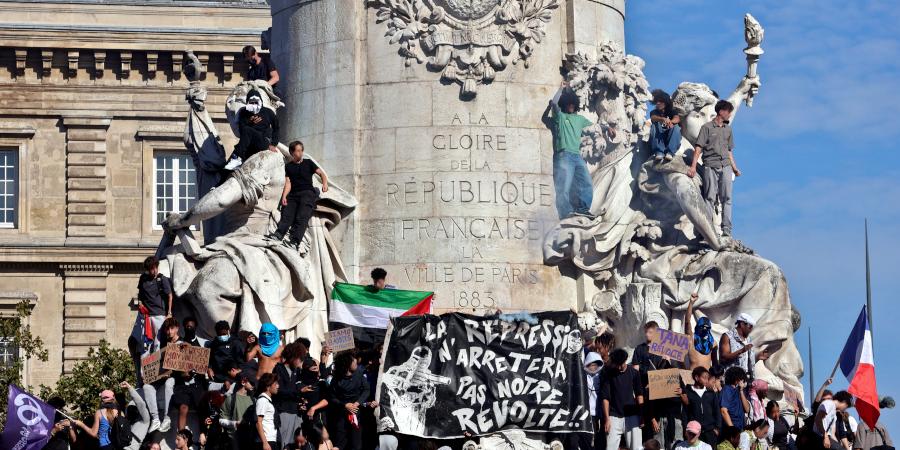
The French Republic’s schools flare up. Starting from the blockade of a high school in Créteil on 18 September, mobilisations by high schoolers have rapidly proliferated throughout the country, especially in poorer neighbourhoods. Their demands and complaints are multiple: recruitment to compensate for unfulfilled class hours due to lack of teachers, renovation of run-down and dilapidated schools, not enough school materials, crowded classrooms, removal of Parcoursup – the ultra-elitist system that decides whether and where students go to university, that aims to reproduce class domination and sort the so-called ‘good’ students from the ‘bad’, that is to say sort the young bourgeois destined to the ‘Big Schools’ of France’s higher education system from the young workers destined to enter the labour market and be exploited as soon as possible.
It’s not by chance that the movement has started most often from the ‘professional’ high schools of the working-class districts, as opposed to the ‘general’ high schools. These youth, sons and daughters of workers and future workers themselves, are the first victims of the Republic’s schools and its sham meritocracy. They are the first to feel the austerity attacks of the bourgeois state, attacks that will amplify in the years to come. It is also they who ‘study’ in schools that lack staff and materials with shabby buildings and where there is no possibility of social mobility. It is a class education that massively reproduced the inequalities of birth. Now, the movement has even reached francophone Belgium.
In capitalist society, school cannot make young workers free. On the contrary, it is a powerful means of segregation, aiming to crush, indoctrinate, sort, and make them believe they have the same chances as everyone and that it is only through work that they will get a better situation. What this movement expresses is the disbelief in the fable of equal opportunities. For them, to attack schools is to make manifest their legitimate disgust for these hated institutions.
Make no mistake: these demands go beyond the situation of high schools in France. It is a revolt against the whole system that no longer promises them a future, except a future of studying and working in misery, and then going off to war. Expressed here is a demand for dignity, a refusal to passively accept this miserable life.
Faced with this spontaneous movement, the bourgeoisie has had only one response: send its militia (CRS and BRAV-M, police with a reputation for ultra-violence) repress the young workers in order to silence them. The results are already alarming: over 5,000 arrests in only a matter of days and several lost eyes. The Minister of the Interior, Laurent Nuñez, thus declared on the 2 October that there “is no order for restraint and no order to not use all the weapons at the disposition of the interior security forces” against the high schoolers.(1) The message is clear. The youth are defending themselves as best they can, with all the means at their disposal, and we can only be happy they do so.
To attack the state, its symbols, and its forces of repression demonstrates an understanding of the antagonism between them and these institutions that are alien to them, that are irremediably their enemies.
But this understanding is still partial and confused, as shown by the presence of too many French flags, leftist slogans, demands for a ‘true school for the people’, and renditions of the Marseillaise. This is also shown by those who wish to lead this movement. The false friends of the working class are numerous, including within its youth. First and foremost, France Insoumise, with its presidential candidate Jean-Luc Mélenchon. After attempting to capitalise on the movement, by showing up at pickets with thunderous applause and the 2027 elections in mind,(2) these humanists now call for ‘non-violence’ and plead not to respond to police ‘provocations’. They ask to show the other cheek! The general secretary of the French ‘Communist’ Party, for his part, ‘condemns’ the rioters and the young ‘delinquents’.
But the ‘reformist’ Left is not the only trap. Trade unions are also trying to stay in control of the movement. On 2 October, the high schooler unions went to the Ministry of Education to negotiate the end of the protests in exchange for certain demands, but were not heard by the government. The inter-union alliance, for its part, is calling for protests against the state budget… in a month from now! The struggle is not theirs; the struggle is that of the workers and young workers that must organise themselves in independent General Assemblies in order to enlarge to the movement.
The far-Left of capital, for its part, sees in these protests a supposed ‘revolutionary upheaval’. Révolution Permanente, with its union Le Poing Levé, finds that the struggle of the high schoolers is in truth a struggle of _'zbeul'_ (disorder) against 'order'. (3) Gone is the long history of class struggle: the history of class societies is in truth determined by the generational struggle of the anti-authoritarian youth and Authority. This vulgar version of anarchism – which sees in every supposedly ‘revolutionary’(4) protest an opportunity for cheap political recuperation, with only a dead end as its result – shows the real danger that these groups are to class consciousness. A thousand leagues away from the independent and autonomous struggle of the proletariat, Révolution Permanente confines the struggle to interclassism, calling to pseudo-convergences with the struggles of university students, farmers or even Yellow Vests. Because they see revolution everywhere, even when it only exists in speeches as is the case today, they will, like Icarus, burn their wings.
Another weakness of this movement concerns its class nature. The youth are not a class. The youth is not and has never been the vanguard of the revolutionary movement, contrary to what leftist groups (Trotskyists, Maoists, or Stalinists) like to pretend. The youth can be bourgeois as well as proletarian, and its class interests thus differ. To those who say that the youth is a new revolutionary subject, including some within the Communist Left, we reaffirm that the only revolutionary class, as a class exploited by capital, is the proletariat. It is only the working class that can, through its struggle, end the barbarism towards which capitalism is dragging us, due to its place within production relations. The proletarian youth have legitimate demands, but they can only go somewhere if they remove themselves from the ambient interclassism, avoid the democratic trap, and unite with other workers, not only educational staff or university students as many leftists call for, but with the whole of the working class. Blocking high schools and universities cannot be an end in itself. It is by the generalisation and extension of the struggle on unitary watchwords – against austerity, precarity, the degradation of living conditions, working conditions, and studying conditions – that it will be possible to upend not only the unending attacks of a bourgeoisie ready for class war, but also the foundations of this system based on the exploitation of wage-labourers by capital. This necessarily supposes a direct confrontation with the state and its forces of repression, since the bourgeoisie today no longer cedes reforms as easily as it used to, but also with its appendixes that are the left-wing bourgeois parties and the unions. It is only through the autonomous and independent organisation of the proletariat as an international class Party that it will be possible to link together these immediate demands, the crisis of capital, and the necessity of a revolutionary response to a bourgeoisie that is dragging us towards war.
-- Xav _
Groupe révolutionnaire internationaliste _
6 October 2026
== Notes:
Image: FreCha (CC BY-SA 4.0), https://commons.wikimedia.org/wiki/File:Manifestation_lyc%C3%A9enne_du_…

(1) https://contre-attaque.net/2026/10/03/aucune-consigne-de-retenue-nunez-…
(2) A tactic that is clearly successful, as demonstrated by the presence of numerous flags and stickers of the party during the protests of 6 October, and by the warm applause of the high schoolers after each intervention by the party’s representatives.
(3) Révolution Permanente is a Trotskyist group associated with Morenism. https://www.revolutionpermanente.fr/Un-air-de-Grand-Refus
(4) One of the Trotskyist slogans of the 60s and 70s in France was _‘tout ce qui bouge est rouge’_ (all that moves is red), May 68 being understood as a repeat of 1905. The poverty of activism!